Topic: Confirmed by NASA, tomorrow will be a special day. It is the day that the Earth will be closest to
+Nugget Syntaxroll !Uvm54ORbmo — 9.7 years ago #46,278
2017. Be sure to spent this memorable day with your beloved one, or else you'd have to wait till 1/1/2018 for it to happen again.
+Syntax — 9.7 years ago, 9 minutes later[T] [B] #503,586
 You won't feel it
+Syntax — 9.7 years ago, 8 minutes later, 17 minutes after the original post[T] [B] #503,587
 There are many a close encounters - Mars to Earth Venus to Earth Moon to Earth ET close to Earth
Now eye don't No about Jan 30th but Earth closest to sun on January 4 2017
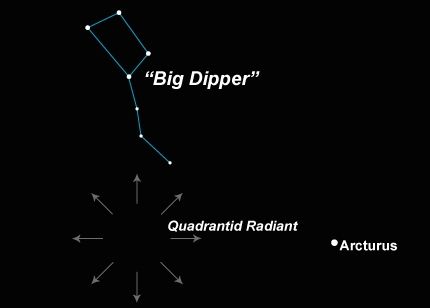
Tonight, a possible meteor shower? The annual Quadrantid shower comes every year at this time. It’s nominally active during the first week of January and best seen from Earth’s northerly latitudes. However, peak activity lasts less than a day, and you need to be on Earth’s night side during the Quadrantids’ short peak. Who will see the shower in 2017? Hard to say. Different sources sometimes list different peak times for meteor showers. For the 2017 Quadrantids, we’re finding some agreement that the peak is due Tuesday, January 3 at 15 hours UTC; translate to your time zone here.
If the peak does occur then, the Americas will have better luck on the morning of January 3.
ON in Asia should try the hours after midnight on the morning of January 4.
For all of us, some good new. In 2017, the waxing crescent moon will leave the sky during the evening hours. For all of us, the hours between midnight and dawn (either January 3 or 4) will be best.
Will you see any meteors? Maybe!
You wouldn’t think people would be so determined to watch such an iffy shower. The Quadrantid shower has such a narrow peak, lasting for only a few hours. If you miss the peak – which is easy to do – you won’t see many meteors.
But the pay-off can be good! The Quadrantids can match the meteor rates of the better-known August Perseid and December Geminid showers. The shower has been known to produce up to 50-100 or more meteors per hour in a dark sky.
Just know that this meteor shower favors the Northern Hemisphere because its radiant point – the point in the sky from which the meteors appear to radiate – is far to the north on the sky’s dome. So it’s not a globally watched shower, as many are.
If you’re thinking of watching the Quadrantids, do it. Meteor shower peaks are rarely a certainty. It’s nearly always a gamble that a shower will reward you with a good show.
·Syntax — 9.7 years ago, 47 seconds later, 18 minutes after the original post[T] [B] #503,588

+Anonymous D — 9.7 years ago, 8 hours later, 8 hours after the original post[T] [B] #503,614

Start a new topic to continue this conversation.
Or browse the latest topics.