Topic: Boobies: how to get them: a guide
+Anonymous A — 12.4 years ago #33,605
firt do everyting you cn to be retarded man
fuck ur brain up re4al good
take ur risperdal
then u grow boobies
fuck side efeects ur gonna have tits
fuck ur brain up re4al good
take ur risperdal
then u grow boobies
fuck side efeects ur gonna have tits
+ducky — 12.4 years ago, 6 minutes later[T] [B] #385,653
lol
+Jack !UFatvuyTEQ — 12.4 years ago, 3 minutes later, 9 minutes after the original post[T] [B] #385,655

+🐵 !Uvm54ORbmo — 12.4 years ago, 3 minutes later, 13 minutes after the original post[T] [B] #385,656
u just need lots of wendy's
+Anonymous E — 12.4 years ago, 9 hours later, 9 hours after the original post[T] [B] #385,786
 (Citing a deleted or non-existent reply.)
Yang Shaojie feels growing pains in his chest. Every so often he pounds his breastbone with a fist, trying to break up the stuffy tightness that makes it hard to breathe.
Yang is a street cleaner in Beijing. For 10 hours a day, six days a week, he scrubs a block about 2.3 kilometres long in the Guomao area of Chaoyang district .
On top of his meagre wages, the municipal government pays him 15 yuan (HK$19) a day to compensate for breathing bad air. "They call it dust sucker's allowance," he says with a faint smile, before he's overcome by a hacking cough.
The native Chaoyang resident has been sweeping streets for nearly a decade and he notices that Beijing's smoggy days happen more often than in the past. But Yang, who is just over 50, says he's never had his health checked because he can't afford a doctor's visit. Nor has he been told that the high level of fine particles in the air can significantly increase the risk of heart disease, a warning given by the World Health Organisation.
Artist Matt Hope adopts an extreme measure. Photo: ReutersHis protective gear includes a face mask, but he rarely dons it, finding it difficult to inhale through the thick cotton.
"Nobody wants to breathe bad air, but what can I do? I can't quit," he says. "The job pays only about 3,000 yuan a month, but it is a government job. It is stable."
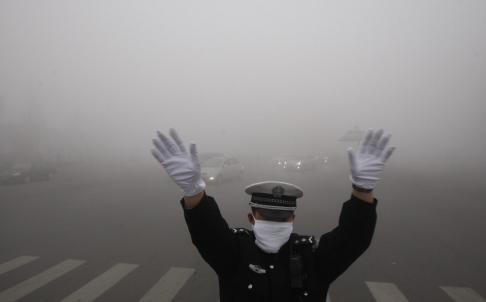
China's capital was hit by some of the worst air pollution on record last winter. Sooty skies plague not only Beijing, but many areas in northern China. There, decades of reliance on coal burning for heat has lowered life expectancy. International researchers found that people in northern China live an average of 5.5 fewer years than residents in the south, according to a study released in July. Last month, after firing up the heating systems in Harbin , the air grew so dense and dirty that schools were closed on October 21.
The Chinese government has launched many measures, such as shutting down small polluting factories, restricting the number of cars on the road and banning outdoor barbecues in downtown areas, but it appears the measures have been in vain.
The central government has tried to induce several regions, including Beijing, to lower pollution levels, even awarding five billion yuan to the city and its surrounding region to cut particulate levels by 25 per cent.
City residents fear that whatever is in the air could be worse this year. Smoggy days started in October, the "golden month" usually known for its blue skies and fresh air. Air pollution has become such an international embarrassment that the Beijing government has introduced strict measures to tackle its acrid skies, including imposing mandatory factory and school closures. Last month the city said it would restrict drivers to using their cars every other day during periods of heavy pollution.
·ducky — 12.4 years ago, 1 hour later, 10 hours after the original post[T] [B] #385,793
pollution sux. egypt has a creepy cloud of it in spring n summer
Start a new topic to continue this conversation.
Or browse the latest topics.