Topic: Differential diagnosis
+Dr. Autphag !MLHqI35Srs — 12.8 years ago #29,213
Since 'tism is bullshit.
| Poll option | Votes | Percentage | Graph |
|---|---|---|---|
| Schizotypy (/personality disorder) | - | 0% | |
| Schizophrenia (paranoid type) | - | 0% | |
| Schizophrenia (any other type; specify below) | - | 0% | |
| Bipolar disorder | - | 0% | |
| Psychotic depression | - | 0% | |
| Avoidant personality disorder | - | 0% | |
| Paranoid personality disorder | - | 0% | |
| Narcissistic grandiosity | - | 0% | |
| Sociopathy | - | 0% |
·Dr. Autphag !MLHqI35Srs (OP) — 12.8 years ago, 42 seconds later[T] [B] #339,896
IMO, nearly all the above apart from perhaps sociopathy apply.
+Anti !M6R0eWkIpk — 12.8 years ago, 8 minutes later, 8 minutes after the original post[T] [B] #339,900
Paranoid Schizophrenia.
·Dr. Autphag !MLHqI35Srs (OP) — 12.8 years ago, 2 minutes later, 10 minutes after the original post[T] [B] #339,901
@previous (Anti !M6R0eWkIpk)
There was an option for that already.
Why not just paranoia without the schizophrenia though (as per the personality disorder or even the feature as a part of its milder variant, schizotypy)? Just curious. I don't suffer particularly strong hallucinations, my affect is fine (in fact a bit exaggerated at times), and although I've anhedonia in some activities, I enjoy what little I care about.
There was an option for that already.
Why not just paranoia without the schizophrenia though (as per the personality disorder or even the feature as a part of its milder variant, schizotypy)? Just curious. I don't suffer particularly strong hallucinations, my affect is fine (in fact a bit exaggerated at times), and although I've anhedonia in some activities, I enjoy what little I care about.
·Anti !M6R0eWkIpk — 12.8 years ago, 12 minutes later, 23 minutes after the original post[T] [B] #339,904
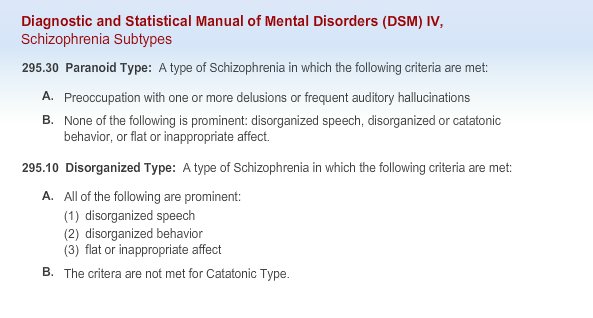 DSM-IV-TR: Diagnostic criteria for schizophrenia: A. Characteristic symptoms: Two (or more) of the following, each present for a significant portion of time during a 1-month period (or less if successfully treated): (1) delusions (2) hallucinations (3) disorganized speech (e.g., frequent derailment or incoherence (4) grossly disorganized or catatonic behaviour (5) negative symptoms, i.e., affective flattening, alogia (poverty of speech), or avolition (lack of motivation) Note: Only one Criterion A symptom is required if delusions are bizarre or hallucinations consist of a voice keeping up a running commentary on the person's behavior or thoughts, or two or more voices conversing with each other. B. Social/occupational dysfunction: For a significant portion of the time since the onset of the disturbance, one or more major areas of functioning such as work, interpersonal relations, or self-care are markedly below the level achieved prior to the onset (or when the onset is in childhood or adolescence, failure to achieve expected level of interpersonal, academic, or occupational achievement). C. Duration: Continuous signs of the disturbance persist for at least 6 months. This 6-month period must include at least 1 month of symptoms (or less if successfully treated) that meet Criterion A (i.e., active-phase symptoms) and may include periods of prodromal (symptomatic of the onset) or residual symptoms. During these prodromal or residual periods, the signs of the disturbance may be manifested by only negative symptoms or two or more symptoms listed in Criterion A present in an attenuated form (e.g., odd beliefs, unusual perceptual experiences). D. Schizoaffective and Mood Disorder exclusion: Schizoaffective Disorder and Mood Disorder With Psychotic Features have been ruled out because either (1) no Major Depressive Episode, Manic Episode, or Mixed Episode have occurred concurrently with the active-phase symptoms; or (2) if mood episodes have occurred during active-phase symptoms, their total duration has been brief relative to the duration of the active and residual periods. E. Substance/general medical condition exclusion: The disturbance is not due to the direct physiological effects of a substance (e.g., a drug of abuse, a medication) or a general medical condition. F. Relationship to a Pervasive Developmental Disorder: If there is a history of Autistic Disorder or another Pervasive Developmental Disorder, the additional diagnosis of Schizophrenia is made only if prominent delusions or hallucinations are also present for at least a month (or less if successfully treated). Subtypes Schizophrenia Subtypes: The subtypes of schizophrenia are defined by the predominant symptomatology at the time of evaluation. Because of the limited value of the schizophrenia subtypes in clinical and research settings (e.g. prediction of course, treatment response, correlates of illness), alternative subtypes are being actively investigates. Subtypes include 1. Paranoid Type 2. Disorganized Type 3. Catatonic Type 4. Undifferentiated Type 5. Residual Type Schizophreniform disorder, schizoaffective disorder, and delusional disorder are closely related to schizophrenia and their symptoms are also listed below. In addition symptoms are listed for the following related disorders: brief psychotic disorder, shared psychotic disorder, psychotic disorder due to a general medical condition, substance-induced psychotic disorder, and psychotic disorder not otherwise specified. 1. Paranoid Type A type of Schizophrenia in which the following criteria are met: A. Preoccupation with one or more delusions or frequent auditory hallucinations. B. None of the following is prominent: disorganized speech, disorganized or catatonic behavior, or flat or inappropriate affect. 2. Disorganized Type A type of Schizophrenia in which the following criteria are met: A. All of the following are prominent: (1) disorganized speech (2) disorganized behaviour (3) flat or inappropriate affect B. The criteria are not met for Catatonic Type. 3. Catatonic Type A type of Schizophrenia in which the clinical picture is dominated by at least two of the following: (1) motoric immobility as evidenced by catalepsy (including waxy flexibility) or stupor (2) excessive motor activity (that is apparently purposeless and not influenced by external stimuli) (3) extreme negativism (an apparently motiveless resistance to all instructions or maintenance of a rigid posture against attempts to be moved) or mutism (4) peculiarities of voluntary movement as evidenced by posturing (voluntary assumption of inappropriate or bizarre postures) (5) stereotyped movements, prominent mannerisms, or prominent grimacing (6) echolalia (word repetition) or echopraxia (repetitive imitation) 4. Undifferentiated Type A type of Schizophrenia in which symptoms that meet Criterion A are present, but the criteria are not met for the Paranoid, Disorganized, or Catatonic Type. 5. Residual Type A type of Schizophrenia in which the following criteria are met: A. Absence of prominent delusions, hallucinations, disorganized speech, and grossly disorganized or catatonic behavior. B. There is continuing evidence of the disturbance, as indicated by the presence of negative symptoms or two or more symptoms listed in Criterion A for Schizophrenia, present in an attenuated form (e.g., odd beliefs, unusual perceptual experiences). Diagnostic criteria for Schizophreniform Disorder: A. Criteria A, D, and E of Schizophrenia are met. B. An episode of the disorder (including prodromal, active, and residual phases) lasts at least 1 month but less than 6 months. (When the diagnosis must be made without waiting for recovery, it should be qualified as "Provisional.") Specify if: Without Good Prognostic Features With Good Prognostic Features: as evidenced by two (or more) of the following: (1) onset of prominent psychotic symptoms within 4 weeks of the first noticeable change in usual behavior or functioning (2) confusion or perplexity at the height of the psychotic episode (3) good premorbid social and occupational functioning (4) absence of blunted or flat affect Diagnostic criteria for Schizoaffective Disorder: A. An uninterrupted period of illness during which, at some time, there is either a Major Depressive Episode, a Manic Episode, or a Mixed Episode concurrent with symptoms that meet Criterion A for Schizophrenia. Note: The Major Depressive Episode must include Criterion A1: depressed mood. B. During the same period of illness, there have been delusions or hallucinations for at least 2 weeks in the absence of prominent mood symptoms. C. Symptoms that meet criteria for a mood episode are present for a substantial portion of the total duration of the active and residual periods of the illness. D. The disturbance is not due to the direct physiological effects of a substance (e.g., a drug of abuse, a medication) or a general medical condition. Specify type: Bipolar Type: if the disturbance includes a Manic or a Mixed Episode (or a Manic or a Mixed Episode and Major Depressive Episodes) Depressive Type: if the disturbance only includes Major Depressive Episodes Diagnostic criteria for Delusional Disorder: A. Nonbizarre delusions (i.e., involving situations that occur in real life, such as being followed, poisoned, infected, loved at a distance, or deceived by spouse or lover, or having a disease) of at least 1 month's duration. B. Criterion A for Schizophrenia has never been met. Note: Tactile and olfactory hallucinations may be present in Delusional Disorder if they are related to the delusional theme. C. Apart from the impact of the delusion(s) or its ramifications, functioning is not markedly impaired and behavior is not obviously odd or bizarre. D. If mood episodes have occurred concurrently with delusions, their total duration has been brief relative to the duration of the delusional periods. E. The disturbance is not due to the direct physiological effects of a substance (e.g., a drug of abuse, a medication) or a general medical condition. Specify type (the following types are assigned based on the predominant delusional theme): Erotomanic Type: delusions that another person, usually of higher status, is in love with the individual Grandiose Type: delusions of inflated worth, power, knowledge, identity, or special relationship to a deity or famous person Jealous Type: delusions that the individual's sexual partner is unfaithful Persecutory Type: delusions that the person (or someone to whom the person is close) is being malevolently treated in some way Somatic Type: delusions that the person has some physical defect or general medical condition Mixed Type: delusions characteristic of more than one of the above types but no one theme predominates Unspecified Type Diagnostic criteria for Brief Psychotic Disorder: A. Presence of one (or more) of the following symptoms: (1) delusions (2) hallucinations (3) disorganized speech (e.g., frequent derailment or incoherence) (4) grossly disorganized or catatonic behavior Note: Do not include a symptom if it is a culturally sanctioned response pattern. B. Duration of an episode of the disturbance is at least 1 day but less than 1 month, with eventual full return to premorbid level of functioning. C. The disturbance is not better accounted for by a Mood Disorder With Psychotic Features, Schizoaffective Disorder, or Schizophrenia and is not due to the direct physiological effects of a substance (e.g., a drug of abuse, a medication) or a general medical condition. Specify if: With Marked Stressor(s) (brief reactive psychosis): if symptoms occur shortly after and apparently in response to events that, singly or together, would be markedly stressful to almost anyone in similar circumstances in the person's culture Without Marked Stressor(s): if psychotic symptoms do not occur shortly after, or are not apparently in response to events that, singly or together, would be markedly stressful to almost anyone in similar circumstances in the person's culture With Postpartum Onset: if onset within 4 weeks postpartum Diagnostic criteria for Shared Psychotic Disorder (Folie à Deux): A. A delusion develops in an individual in the context of a close relationship with another person(s), who has an already-established delusion. B. The delusion is similar in content to that of the person who already has the established delusion. C. The disturbance is not better accounted for by another Psychotic Disorder (e.g., Schizophrenia) or a Mood Disorder With Psychotic Features and is not due to the direct physiological effects of a substance (e.g., a drug of abuse, a medication) or a general medical condition. Diagnostic criteria for Psychotic Disorder Due to a General Medical Condition: A. Prominent hallucinations or delusions. B. There is evidence from the history, physical examination, or laboratory findings that the disturbance is the direct physiological consequence of a general medical condition. C. The disturbance is not better accounted for by another mental disorder. D. The disturbance does not occur exclusively during the course of a Delirium. Code based on predominant symptom: - With Delusions: if delusions are the predominant symptom - With Hallucinations: if hallucinations are the predominant symptom Diagnostic criteria for Substance-Induced Psychotic Disorder: A. Prominent hallucinations or delusions. Note: Do not include hallucinations if the person has insight that they are substance induced. B. There is evidence from the history, physical examination, or laboratory findings of either (1) or (2): (1) the symptoms in Criterion A developed during, or within a month of, Substance Intoxication or Withdrawal (2) medication use is etiologically related to the disturbance C. The disturbance is not better accounted for by a Psychotic Disorder that is not substance induced. Evidence that the symptoms are better accounted for by a Psychotic Disorder that is not substance induced might include the following: the symptoms precede the onset of the substance use (or medication use); the symptoms persist for a substantial period of time (e.g., about a month) after the cessation of acute withdrawal or severe intoxication, or are substantially in excess of what would be expected given the type or amount of the substance used or the duration of use; or there is other evidence that suggests the existence of an independent non-substance-induced Psychotic Disorder (e.g., a history of recurrent non-substance-related episodes). D. The disturbance does not occur exclusively during the course of a delirium. Note: This diagnosis should be made instead of a diagnosis of Substance Intoxication or Substance Withdrawal only when the symptoms are in excess of those usually associated with the intoxication or withdrawal syndrome and when the symptoms are sufficiently severe to warrant independent clinical attention. Diagnostic Criteria for Psychotic Disorder Not Otherwise Specified: This category includes psychotic symptomatology (i.e., delusions, hallucinations, disorganized speech, grossly disorganized or catatonic behavior) about which there is inadequate information to make a specific diagnosis or about which there is contradictory information, or disorders with psychotic symptoms that do not meet the criteria for any specific Psychotic Disorder. Examples include: 1. Postpartum psychosis that does not meet criteria for Mood Disorder With Psychotic Features, Brief Psychotic Disorder, Psychotic Disorder Due to a General Medical Condition, or Substance-Induced Psychotic Disorder 2. Psychotic symptoms that have lasted for less than 1 month but that have not yet remitted, so that the criteria for Brief Psychotic Disorder are not met 3. Persistent auditory hallucinations in the absence of any other features 4. Persistent nonbizarre delusions with periods of overlapping mood episodes that have been present for a substantial portion of the delusional disturbance 5. Situations in which the clinician has concluded that some type of psychotic disorder may be present, but is unable to determine whether it is primary, due to a general medical condition, or substance induced.
+Anonymous C — 12.8 years ago, 14 minutes later, 37 minutes after the original post[T] [B] #339,905
+Anonymous D — 12.8 years ago, 16 minutes later, 53 minutes after the original post[T] [B] #339,907
@OP
> Doesn't trust the diagnosis of medical professionals
> Asks a group of people on an internet bbs for a diagnosis
Kill yourself to fix your problem.
> Doesn't trust the diagnosis of medical professionals
> Asks a group of people on an internet bbs for a diagnosis
Kill yourself to fix your problem.
·Anti !M6R0eWkIpk — 12.8 years ago, 2 minutes later, 55 minutes after the original post[T] [B] #339,908
 @339,905 (C)
Prolly, I imagine he knows he's a bit off but he posts nonsense like this to guage how batshitcrazy other people think he is.
+Morbid !vbsvhaneDY — 12.8 years ago, 1 minute later, 57 minutes after the original post[T] [B] #339,910

·Dr. Autphag !MLHqI35Srs (OP) — 12.8 years ago, 1 hour later, 2 hours after the original post[T] [B] #339,921
+Triptych !IupsXZPnnU — 12.8 years ago, 4 minutes later, 2 hours after the original post[T] [B] #339,923
Techniques for differentiation:
Derivative of a constant:
if f(x) = k
then f'(x) = 0
Power rule:
If f(x) = ax^n
then f'(x) = anx^(n-1)
sum/difference of functions:
if f(x) = g(x) + h(x)
then f'(x) = g'(x) + h'(x)
Product rule:
Given f(x) = g(x)h(x)
f'(x) = g'(x)h(x) + g(x)h'(x)
quotient rule:
given f(x) = g(x)/h(x)
f'(x) = (g'(x)h(x) - g(x)h'(x))/(h(x)^2)
The chain rule:
if f(x) = g(h(x))
then f'(x) = g'(h(x))*h'(x)
hope this helps~
Derivative of a constant:
if f(x) = k
then f'(x) = 0
Power rule:
If f(x) = ax^n
then f'(x) = anx^(n-1)
sum/difference of functions:
if f(x) = g(x) + h(x)
then f'(x) = g'(x) + h'(x)
Product rule:
Given f(x) = g(x)h(x)
f'(x) = g'(x)h(x) + g(x)h'(x)
quotient rule:
given f(x) = g(x)/h(x)
f'(x) = (g'(x)h(x) - g(x)h'(x))/(h(x)^2)
The chain rule:
if f(x) = g(h(x))
then f'(x) = g'(h(x))*h'(x)
hope this helps~
·Dr. Autphag !MLHqI35Srs (OP) — 12.8 years ago, 5 minutes later, 2 hours after the original post[T] [B] #339,924
@previous (Triptych !IupsXZPnnU)
> soulless Indian rote-automaton
Not what I even asked for. I hope you return to your country of ethnic origin after graduating.
> soulless Indian rote-automaton
Not what I even asked for. I hope you return to your country of ethnic origin after graduating.
·Triptych !IupsXZPnnU — 12.8 years ago, 3 minutes later, 2 hours after the original post[T] [B] #339,926
+Anonymous G — 12.8 years ago, 15 minutes later, 2 hours after the original post[T] [B] #339,929
·Anonymous D — 12.8 years ago, 30 minutes later, 3 hours after the original post[T] [B] #339,932
·Dr. Autphag !MLHqI35Srs (OP) — 12.8 years ago, 1 minute later, 3 hours after the original post[T] [B] #339,933
@previous (D)
I haven't done it in 30 years in all fairness. I got to about where Triptych is now before completing secondary and never used it again since.
I haven't done it in 30 years in all fairness. I got to about where Triptych is now before completing secondary and never used it again since.
·Anonymous D — 12.8 years ago, 4 minutes later, 3 hours after the original post[T] [B] #339,934
+FuckAlms !vX8K53rFBI — 12.8 years ago, 32 minutes later, 3 hours after the original post[T] [B] #339,940
·Anonymous D — 12.8 years ago, 7 minutes later, 3 hours after the original post[T] [B] #339,943
+Anti — 12.8 years ago, 1 hour later, 5 hours after the original post[T] [B] #339,970
+ducky !MwWb.dJjRc — 12.8 years ago, 9 minutes later, 5 hours after the original post[T] [B] #339,973
williams syndrome. whos with me?
·Anti !M6R0eWkIpk — 12.8 years ago, 1 hour later, 7 hours after the original post[T] [B] #340,042
Start a new topic to continue this conversation.
Or browse the latest topics.